10 Key Hospitality Technology Trends to Watch in 2026
Explore how AI, IoT, and smart hotel systems are transforming hospitality in 2026. Learn what top hotels are doing to delight guests and grow faster.

In this article
Short answer
RaftLabs builds hospitality technology for hotels, serviced apartments, and boutique properties. The top 2026 trends are AI dynamic pricing, contactless mobile check-in, cloud PMS with open APIs, voice AI, and IoT smart rooms. Hotels using AI revenue management report 10-15% RevPAR gains in the first 12 months. Cloud PMS reduces admin costs by close to 30%. Properties that connect these 5 systems outperform peers on direct bookings and guest satisfaction.
Key takeaways
- AI pricing tools need 12-24 months of clean historical data to produce reliable recommendations. Properties that deploy AI revenue management on top of a messy legacy PMS consistently see the tool underperform. Fix the data layer before the AI layer.
- Mobile check-in doesn't fail because guests don't want it. It fails because the PMS integration isn't real-time. Properties on pre-2020 legacy PMS platforms face $15K-$40K integration costs before a single guest can use contactless check-in.
- IoT smart room retrofits cost $800-$3,000 per room in equipment alone. Older buildings with concrete walls and limited in-room wiring can add 18 months and significant infrastructure cost to what looks like a simple hardware rollout.
- Voice AI in hotel rooms still has a noise problem. Consumer hardware like Amazon Alexa misses 30-40% of commands in urban hotel rooms above the 5th floor due to HVAC and street noise. Custom dedicated hardware performs better but costs 3-5x more per room.
- The properties outperforming on direct bookings in 2026 aren't spending more on marketing. They're spending on booking engine and PMS integration, converting the 18% of guests who start on an OTA but would book direct given a better experience.
82% of hotels are actively expanding AI adoption in 2026, and 71% of hospitality professionals say it's already having a significant impact on their operations. Hotels investing in AI, mobile-first check-in, contactless payments, voice front-desk automation, and dynamic revenue management are reporting higher guest satisfaction scores and lower operating costs. Those delaying are losing ground.
This article covers the 10 technology trends shaping hospitality in 2026, what each one delivers, and how to prioritize investment based on your property type and scale.
What is hospitality technology?
Hospitality technology is the set of tools and systems that help staff, operations, and guests interact without friction. It includes:
property management systems
AI-powered booking systems
mobile guest services
smart hotel technology
Hotels, resorts, serviced apartments, and other guest-focused businesses no longer run on staff and checklists alone. Today, hospitality technology solutions form the backbone of smooth operations and memorable guest experiences.
Guests can control room settings with smart room controls, request services from their phones, and get personalized recommendations - while managers monitor everything in real time using predictive analytics for hotels.
The real power of hospitality software comes from integration. When hotel PMS, CRM, guest apps, and analytics systems work together, operators get clarity on operations and guest behavior. That clarity speeds up decisions, improves efficiency, and makes every stay run smoothly.
Check out: Our Travel and Hospitality Development Services to build your tailored product or software for your business.
Why hospitality technology matters in 2026
Growth is strong. The industry has expanded steadily and is expected to continue growing around 6% each year over the next decade. New hotel construction in the U.S., Europe, and Asia shows rising demand and confidence. Hotels and resorts aren't just places to sleep - they've become experience hubs where every interaction counts.
Technology is essential for modern hotels
Mobile check-ins, digital keys, and self-service kiosks are no longer extras. Leading hotels are using AI in the hospitality industry, IoT, and other hotel technology innovations to forecast occupancy, personalize room experiences, and optimize pricing.
We've built guest apps for boutique hotels and serviced apartment brands. Explore our hotel guest app development services -
Personalization drives revenue
Guests who receive tailored experiences - smart room controls, curated recommendations, digital concierge - tend to spend more. Studies show personalized offerings can add around $20 per night per guest. Across a full property, that compounds quickly.
Operational efficiency is more important than ever
Labor shortages and rising costs mean hotels need cloud-based hotel management systems, automation, and integrated platforms. These solutions cut steps from workflows, resolve issues faster, and free staff to focus on meaningful guest interactions.
Sustainability is part of the business case now
Energy and water monitoring, smart hotel technology, and data-driven resource management reduce costs and appeal to eco-conscious travelers. Hotels that adopt these practices improve their brand while seeing measurable operational savings.
Hospitality today is about rethinking every detail. The most successful properties use technology thoughtfully, delight guests with personalized service, and build operations that scale.
Benefits of hospitality technology for hotels and resorts
1. Smarter and leaner operations
Hotels that integrate technology run more efficiently. Predictive maintenance, workflow automation, and resource optimization reduce manual effort, freeing staff to focus on high-touch services guests remember.
2. Personalized guest experiences
AI-powered systems let hotels anticipate guest needs and tailor services. In Singapore, some hotels use AI along with hotel guest experience apps to recommend local attractions or dining options, creating stays that feel personal while encouraging repeat visits.
3. Scalable multi-property management
Cloud-based management systems make it straightforward to manage multiple properties. European hotel chains rely on cloud PMS platforms to push updates across dozens of locations while maintaining consistent service standards.
4. Revenue growth with AI tools
AI-driven booking and revenue management systems open new income streams. Boutique hotels in the U.S. report earning an extra $20 per night per guest through targeted upselling of amenities and dynamic pricing adjustments.
5. Connected digital guest experiences
Contactless check-ins, mobile keys, and IoT-enabled rooms are standard in Japan, giving guests smooth, mobile-first experiences. Technology delivers convenience and safety reliably rather than depending on front-desk availability.
6. Technology-enabled sustainability
IoT and data analytics help monitor and reduce energy, water, and resource use. Scandinavian eco-resorts track energy consumption with smart systems, saving costs while appealing to environmentally conscious travelers.
7. Forward-thinking brand positioning
Hotels that adopt technology early stand out in competitive markets. Investing in AI, smart rooms, and integrated platforms builds loyalty, attracts corporate clients, and positions properties as modern and guest-focused.
Adopting the right technology improves operations, drives growth, and builds the infrastructure for long-term success.
Discover a better way to run your hospitality business Want to see how a custom-built hospitality platform can simplify your operations and boost revenue? Schedule a call now
Latest hospitality technology trends of 2026
| Sl.No. | Trend | Investment range | Impact |
|---|---|---|---|
| 1 | Artificial Intelligence (AI) | $20K-$150K initial + $500-$3K/month | Optimizes pricing, predicts occupancy, recommends add-ons, and personalizes guest experiences. |
| 2 | Contactless and mobile journeys | $15K-$60K initial + $300-$1.5K/month | Enables frictionless check-ins, keyless room access, and app-based concierge services. |
| 3 | Cloud PMS and open integrations | $10K-$80K initial + $3-$15/room/month | Simplifies multi-property management and speeds up decision-making. |
| 4 | Voice AI and voice search | $25K-$120K initial + $800-$2.5K/month | Provides hands-free guest interactions, speeds up service, and reduces staff workload. |
| 5 | Face recognition technology | $40K-$150K initial + $500-$2K/month | Speeds up check-ins while maintaining security and compliance. |
| 6 | Cybersecurity and data privacy | $30K-$200K annually | Protects guest data, prevents breaches, and builds trust. |
| 7 | Smart rooms and IoT integration | $800-$3,000 per room | Automates room controls, flags maintenance issues early, and cuts energy costs. |
| 8 | Sustainability and energy management | $50K-$300K initial + $200-$1K/month | Reduces resource waste, supports eco-friendly operations, and appeals to conscious travelers. |
| 9 | Virtual and augmented reality (VR/AR) | $30K-$120K initial + $500-$1.5K/month | Improves guest engagement, pre-booking experiences, and staff training. |
| 10 | Robotics and automation | $50K-$400K initial + $1K-$5K/month | Automates routine tasks, raises efficiency, and lets staff focus on high-touch services. |
1. Artificial intelligence
AI is now central to how modern hospitality businesses optimize revenue and personalize guest experiences. For a deeper breakdown, see how AI in travel and hospitality is being used across properties today.
AI does far more than power chatbots in the hospitality industry. It's used for:
predicting occupancy and demand patterns
adjusting room pricing dynamically
recommending add-on services and upgrades
personalizing guest interactions across channels
AI-powered booking systems can suggest rooms based on previous stays, and predictive analytics help revenue teams make smarter pricing decisions faster.
Why it matters: Hotels deploying conversational AI for guest communication handle a significant share of pre-arrival, in-stay, and post-checkout queries without staff involvement. The conversational AI in hospitality guide covers the implementation patterns that work and the ones that frustrate guests.
Hotels using dynamic pricing AI report 15-25% RevPAR improvement in the first 12 months. AI reduces manual work, speeds up decision-making, and makes guests feel understood rather than processed.
The real adoption barrier: Most hotels don't lack budget - they lack clean data. AI pricing engines need 12-24 months of consistent occupancy, rate, and channel data to produce reliable recommendations. Properties running on legacy PMS platforms with inconsistent rate-code structures often find their first AI rollout underperforms because the training data is messy. Fix the data layer first.

2. Contactless and mobile journeys
Guests now expect friction-free experiences at every point of the stay. Key applications include:
mobile check-in and check-out
keyless room access
app-based concierge services
in-app service requests and payments
These technologies let staff spend less time on routine front-desk tasks and focus more on personalizing guest interactions.
Business impact: Hotels adopting mobile journeys consistently report shorter queues, fewer service issues, and higher guest satisfaction - even in smaller and mid-sized properties. Properties that have replaced physical key cards with mobile keys report 18-22% fewer front-desk complaints during high-volume check-in windows.
The real adoption barrier: The main friction isn't technology cost - it's PMS lock-in. Most mobile check-in platforms require a real-time two-way connection to the PMS. Properties on older systems (Opera On-Premise pre-2020, older Maestro versions) may find the integration cost ($15K-$40K) rivals the app itself. Cloud PMS migration is often the prerequisite, not an optional step.
3. Cloud PMS and open integrations
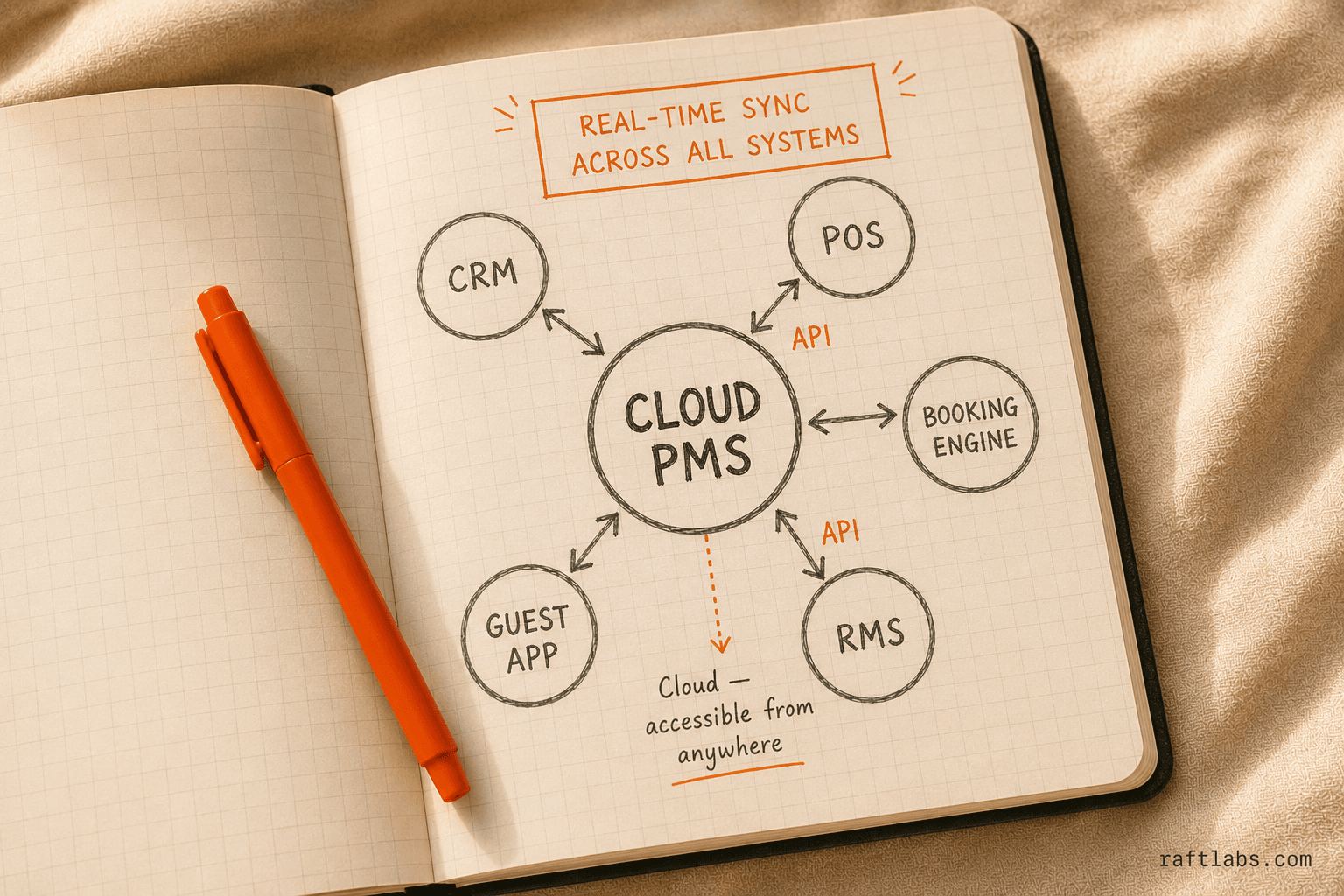
Cloud-based property management systems are the operational backbone of modern hotels. They make managing multiple properties straightforward and let teams access information from anywhere.
Compared to legacy systems, cloud PMS offers:
real-time access from anywhere
easier multi-property management
faster updates and scalability
clean integration with CRM, POS, RMS, and booking engines
When PMS connects with CRM, POS, and booking platforms, reporting gets faster and managers make better decisions without juggling spreadsheets.
See how we build direct booking systems that reduce OTA dependency. View hotel booking app development -
Real-world example: Taj Hotels has been moving its operations to cloud-based infrastructure using Fidelio as its core PMS. Modernizing their PMS made scaling across multiple properties easier and gave staff consistent tools for guest service delivery.
The real adoption barrier: Cloud PMS migration is a 6-18 month project, not a software swap. The hidden cost is data migration and staff retraining. A property with 5 years of guest history in a legacy system faces a decision about whether to migrate that history (expensive, error-prone) or start fresh (loses personalization data). Most properties underestimate retraining time - front-desk staff who've worked a legacy system for years need 4-8 weeks to reach the same proficiency on a new platform.
4. Voice AI and voice search
Voice-enabled technology is redefining convenience in hospitality. Some hotels are using voice AI assistants so guests can make requests hands-free.
Hotels and cruise lines use voice AI for:
in-room control of lighting, temperature, and entertainment
voice-based service requests
voice-enabled booking and concierge systems
Example: MSC Cruises' assistant "Zoe" answers questions about onboard activities, dining, and excursions, while also letting passengers control cabin settings and make bookings.
Why this trend is growing: Voice AI centralizes information, reduces staff workload, and delivers highly personalized, hands-free guest experiences. It's especially valuable in luxury and premium segments where guests expect immediate, accurate responses at any hour.
Voice AI agents handling pre-arrival and in-stay queries typically deflect 40-60% of calls that previously required a live agent - which translates directly to front-desk labor savings.
The real adoption barrier: Wake-word reliability in noisy hotel rooms (HVAC, TV, street noise) is still an unsolved problem for consumer hardware. Properties that deploy Amazon Alexa or Google Nest in rooms often see 30-40% of voice commands misheard or ignored in rooms above the 5th floor of urban properties. Custom voice agents built on dedicated hardware with noise-cancellation firmware perform better but cost 3-5x more per room.
Building an AI concierge or voice agent for your property? Talk to our team
5. Face recognition technology
Hotels use facial recognition to speed up check-ins while keeping security tight.
Common uses include:
faster, touchless check-ins
identity verification
personalized service recognition
Guests move through identity verification quickly, and staff can focus on delivering service rather than processing paperwork. Well-built systems balance speed with privacy and compliance.
Example: Hotels like the Hilton in select locations are using face recognition to speed up check-ins while staying compliant with privacy laws.
The real adoption barrier: GDPR in Europe and state-level biometric privacy laws in the U.S. (Illinois BIPA, Texas CUBI) create significant legal exposure. Properties in Illinois, for example, need explicit written consent before collecting biometric data - a requirement that adds friction to the check-in flow and creates liability if consent records aren't maintained. Hotels pursuing facial recognition need legal review before any pilot, not after.
6. Cybersecurity and data privacy
As hospitality becomes more digital, cybersecurity is a boardroom priority. Hotels collect large amounts of sensitive guest data - from identity details to payment information - and protecting it is critical.
Modern hospitality cybersecurity focuses on:
data encryption
threat detection and monitoring
compliance with data protection laws (GDPR, etc.)
secure integrations across systems
Why it matters: Strong security prevents breaches, builds trust, and protects long-term customer loyalty. The average cost of a data breach in hospitality reached $3.36 million in 2024, and brand damage from a publicly disclosed breach typically takes 2-3 years to recover from.
The real adoption barrier: Most security gaps in hospitality aren't in the PMS - they're in the network perimeter. Guest Wi-Fi networks that share infrastructure with back-office systems, outdated POS terminals running Windows 7, and third-party booking engine integrations with weak API authentication are the most common entry points. A full security audit typically surfaces 8-15 critical vulnerabilities in a mid-sized property before any new investment is justified.
7. Smart rooms and IoT integration
IoT technology is changing how hotels manage rooms and energy use.
Smart hotel rooms use connected devices to:
adjust lighting and temperature automatically
optimize HVAC based on occupancy and weather
monitor equipment health in real time
flag maintenance issues before they affect guests
Energy gets used only where it's needed, cutting waste and lowering operating costs while improving guest comfort.
Real-world impact: Oootopia, a serviced apartment brand in Hong Kong, uses IoT to automate property management with a focus on energy efficiency. After adopting IoT solutions, they saw up to 30% reductions in HVAC energy consumption.
Serviced apartments and extended-stay properties have distinct operational needs that generic hotel software doesn't address well - lease management, utility tracking, housekeeping scheduling tied to length of stay, and self-check-in flows. Serviced apartment software development built around those specific workflows runs more reliably than a hotel PMS configured to approximate them.
The real adoption barrier: Per-room IoT retrofits cost $800-$3,000 per room plus a central hub and network infrastructure upgrade. A 150-room property is looking at $120K-$450K before labor. The deeper problem is the building itself - older properties with thick concrete walls, limited in-room wiring, and no structured cabling require significant infrastructure investment before any IoT device works reliably. Newer builds with Cat6 wiring and a dedicated IoT VLAN can deploy in weeks; a 1970s convention hotel can take 18 months.
8. Sustainability and energy management
Sustainability is a competitive advantage, not a compliance checkbox.
Hotels use smart technology to:
track and optimize water, power, and HVAC usage
reduce carbon footprints
meet green certification requirements
appeal to eco-conscious travelers
Today's guests actively consider sustainability when choosing accommodations, making energy management systems both a cost-saving and brand-building investment. Properties with LEED or Green Key certification command a 6-10% ADR premium in most markets.
9. Virtual and augmented reality
VR and AR expand guest experiences beyond the physical room.
Use cases include:
virtual property tours before booking
AR-powered in-room guides
immersive destination previews
AR-based staff training simulations
These technologies improve marketing, reduce booking hesitation, and create more engaging guest journeys. Hotels that add virtual tours to their direct booking pages report 20-40% longer session times and measurably lower booking abandonment.
10. Robotics and automation
Automation helps hospitality businesses deal with labor shortages and improve consistency.
Robotics and automation apply across:
room service deliveries
cleaning operations
inventory management
back-office processes
Handling repetitive tasks this way lets staff spend time on high-touch services that create real guest satisfaction. Automation also reduces errors and keeps operations consistent across properties.
Businesses that adopt these tools improve operational efficiency, delight guests, gain a competitive edge, and drive long-term growth. Properties that delay adoption risk falling behind competitors who are already using AI, IoT, and cloud systems to boost revenue, cut operational costs, and create memorable guest experiences.
Check out: Our hotel booking app development services if you're planning to build a hotel booking app for your business.
Which hospitality technologies to prioritize in 2026
| Technology | Investment level | ROI timeline | Priority |
|---|---|---|---|
| Mobile guest app | Medium ($15k-$40k) | 6-12 months | High |
| AI front desk agent | Medium ($20k-$50k) | 6-18 months | High |
| PMS integration | Low-Medium | 3-6 months | Immediate |
| Contactless payments | Low | Immediate | Immediate |
| Dynamic pricing tool | Medium | 3-9 months | Medium |
| AR/VR room previews | High | 18-36 months | Low |
Turning hospitality technology trends into real software solutions
Technology trends are useful context. The real value comes from how hospitality businesses actually build with them. The brands that succeed take these trends and turn them into tools that solve specific problems, make teams work better, and make guests feel cared for.
This applies to hotels, resorts, serviced apartments, boutique stays, and other guest-focused businesses.
Custom property management systems (PMS)
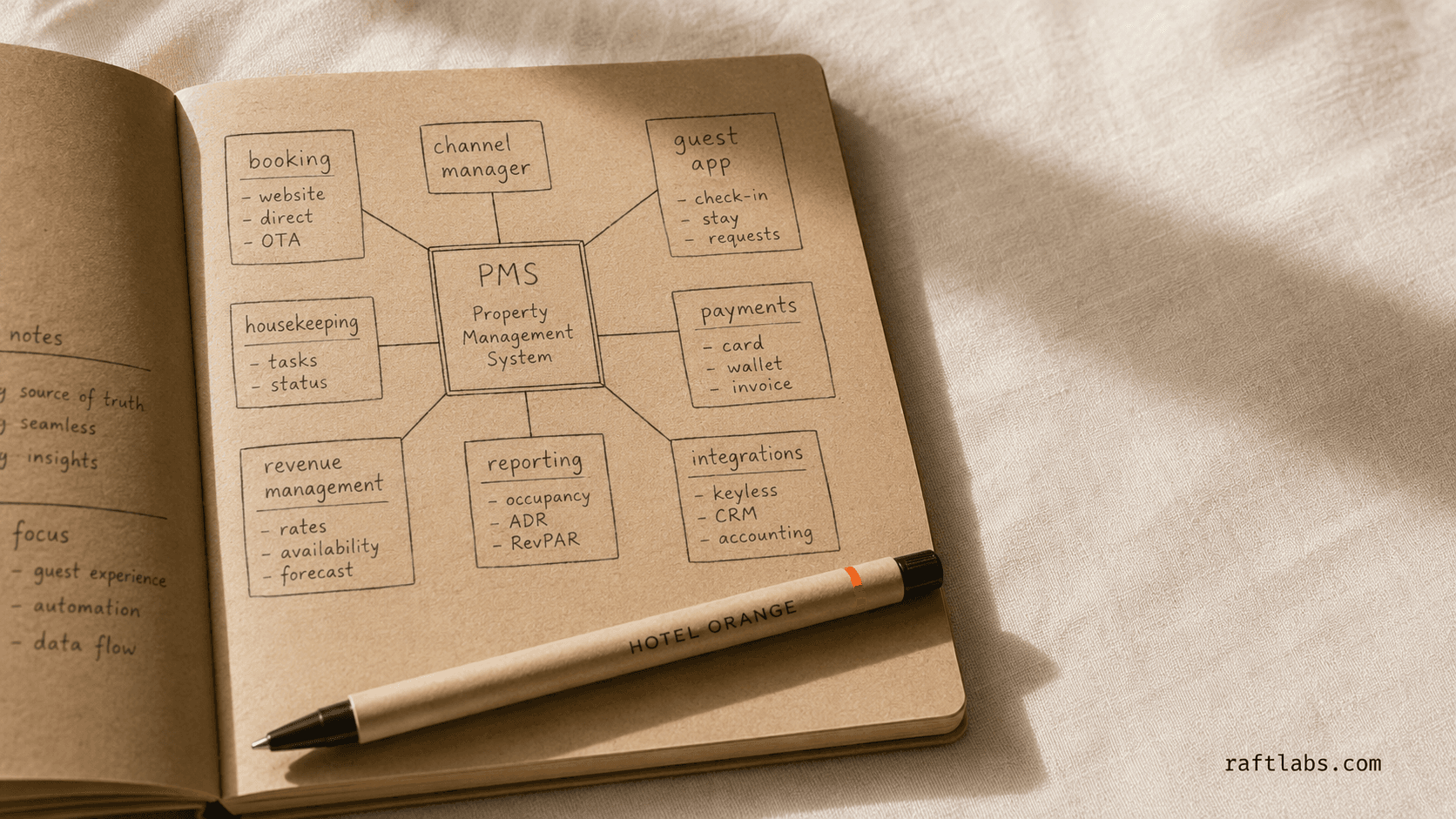
A modern, custom-built PMS is the operational backbone of a hospitality business. A good PMS brings together:
reservations and bookings
billing and invoicing
housekeeping and room status
guest profiles and preferences
staff coordination
With a unified system, staff spend far less time on repetitive tasks and can respond faster to guest needs. Managers see exactly what's happening across operations at any moment.
Business impact:
faster check-ins and check-outs
fewer errors and double bookings
better coordination between departments
scalability for multi-property operations
Guest experience platforms
Guest experience platforms turn personalization into a scalable system. They combine:
AI chatbots and virtual concierges
automated service requests
in-app communication
guest feedback and sentiment tracking
A system might remember a returning guest's preferred room temperature or automatically suggest late check-out based on past behavior. Small, personalized touches dramatically increase satisfaction, loyalty, and repeat bookings - without increasing staff workload.
Inventory and maintenance apps
For bigger properties and multi-location operations, managing physical assets efficiently is as important as managing guests.
These applications connect:
housekeeping updates
maintenance schedules
inventory tracking
purchase and supplier records
Teams can track supplies and room readiness, flag maintenance issues early, and confirm supplies are available where needed.
Operational benefits:
reduced downtime and service delays
lower operational waste
better asset lifecycle management
higher room availability and utilization
Revenue and forecasting tools
AI-powered revenue and analytics platforms move hospitality leaders from reactive to predictive decision-making.
These tools handle:
accurate occupancy forecasting
dynamic pricing optimization
demand-based promotions
scenario planning
Business impact:
higher RevPAR and ADR
smarter promotions
faster pricing decisions
better alignment between sales, marketing, and operations
Check out: Our AI Development Services to integrate AI into your existing systems or to build AI-powered products.
Real-world example: driving results with smart hospitality tech
We recently built a branded booking platform for City Break Apartments, one of Ireland's leading short- and medium-term letting providers, that connects directly with their existing RMS system.
Guests can now browse properties, make direct bookings, and complete self check-ins through the mobile app, using Bluetooth keyless access to their apartments.
Friction dropped and guest satisfaction went up, driving 25% more direct bookings and seven times the number of self check-ins.
Staff gained better control over operations, and the digital experience reflects the brand rather than a generic platform.
Custom booking engine built for effortless guest experiences We helped a leading short and medium-term letting provider simplify guest experiences with a custom-built booking engine. See Case Study
Three key considerations when developing hospitality software
Building or adopting hospitality software isn't just about adding features. It's about creating something that fits the rhythm of your business while keeping up with the latest technology.
1. Integration comes first
Every system should communicate reliably. Your PMS, CRM, POS, and guest experience platforms need to share information without delays or manual effort. Using a hotel PMS integration solution and hotel CRM integration keeps data moving freely, saving staff time and giving guests smoother experiences across all property types.
2. User experience matters for everyone
A platform should feel natural whether it's a front desk team handling check-ins, a resort manager tracking room readiness, or a guest adjusting smart room controls. The simpler the interface, the faster adoption happens - and the better results across departments.
3. Data security and scalability
Guests trust you with personal information, and that trust must be protected. Strong security is non-negotiable. Every solution should also be ready to grow with your business, whether you're adding new properties, rolling out cloud-based hotel management systems, or expanding into new markets.
Top hospitality systems are built to handle today and what's coming next. Get the basics right and the layers of AI-powered booking systems and IoT start delivering real results across hotels, resorts, serviced apartments, and more.
Custom software vs. ready-made solutions for hospitality
Two paths exist for software. You can go with an existing platform that covers the most common operations, or build a custom solution that fits exactly how your business runs.
Off-the-shelf solutions get you started quickly. They handle general operations well, but sometimes don't align with the specific ways your staff and guests interact with your property.
Custom software gives you flexibility. You can add the features that matter most - smart room controls, AI-powered booking systems, predictive analytics, or personalized guest services. The system can grow with your business, scale to new locations, and adapt to evolving guest expectations. Staff can use it naturally and guests enjoy an experience designed for them rather than a generic platform.
It comes down to what your business values more: quick setup or a system built to reflect your brand and operations.
Do a free audit for your booking page and benchmark it against OTA best practices. Get your free report
Choosing the right tech stack
Picking the right technology goes beyond features. It's about building a system that fits how your property actually operates, grows with your business, and responds to guest needs.
Hotels of medium size, boutique resorts, and serviced apartments typically do well with modular cloud systems on Node.js and React, connected to CRM or PMS platforms via APIs.
Bigger chains or groups with many properties go for scalable architectures with AWS, Kubernetes, and enterprise-grade databases to handle large data volumes and multiple sites smoothly.
| Property type | Ideal tech setup | Why it's a good fit | Key capabilities |
|---|---|---|---|
| Medium hotels / boutique resorts / serviced apartments | Cloud-based, modular setup using Node.js and React with open APIs | Easy to plug into existing systems, simple for staff, grows with the business | Sync bookings, automate check-ins, connect PMS and CRM, handle smart room or guest apps |
| Large hotel chains / multi-property groups | Scalable architecture with AWS, Kubernetes, and enterprise databases | Handles larger data volumes, multiple sites, and keeps performance stable | Manage all locations in one place, run predictive analytics, track revenue, manage IoT devices |
| Any modern property | Guest-facing tools that link with staff dashboards | Improves experience and saves time for the team | AI-powered booking, contactless check-in, mobile keys, personalized recommendations |
Think through how the system actually works for guests and staff:
Can it connect cleanly with mobile apps or AI-powered booking tools?
Does it handle smart room controls and IoT in a way that makes life easier for your team?
Can managers see revenue and analytics quickly without extra steps?
The best systems fit into daily operations rather than standing in the way.
At RaftLabs, we focus on lightweight, API-first solutions that integrate with existing tools. This approach makes daily operations easier, reduces maintenance overhead, and grows with your business - whether it's an internal dashboard, a guest-facing app, or a full management suite.
Also Read: Top Hospitality tech companies transforming hotels & travel
How hospitality businesses can adapt technology and win
Hospitality today is about mixing technology with a human touch. It's not about picking every new gadget - it's about the ones that actually make life easier for your team and make stays memorable for guests.
Focus first on the tools that address your biggest challenges: smoother operations, happier guests, controlled costs. A clear plan for which tech to adopt first helps you avoid wasted time and money.
Connect your systems properly. PMS, CRM, and guest apps working together means staff can act fast and guests notice how smooth it all feels.
AI-powered booking systems, predictive analytics, and guest experience platforms make interactions feel personal. A few small touches - recommending a restaurant, handling a special request automatically - can make a meaningful difference.
Mobile check-ins, digital keys, smart room controls are becoming expected. They reduce waiting, make stays convenient, and give your property a modern feel.
Cloud systems are your friend if you manage more than one property. They make scaling simpler, updates easier, and keep operations flexible.
Train your team on these tools. When staff understand why they matter, they use them better and can focus on guests rather than wrestling with tech.
Keep an eye on feedback, occupancy patterns, and operational data. The insights help you improve service and stay ahead.
Protect guest data and monitor energy or water use. It builds trust and sets your property up for the future.
Progress comes bit by bit. Pick tools that match your needs, link your systems, and make sure your team knows how to use them. You'll find your property runs easier, guests are happier, and your business stays ahead.
The ROI of technology in hospitality
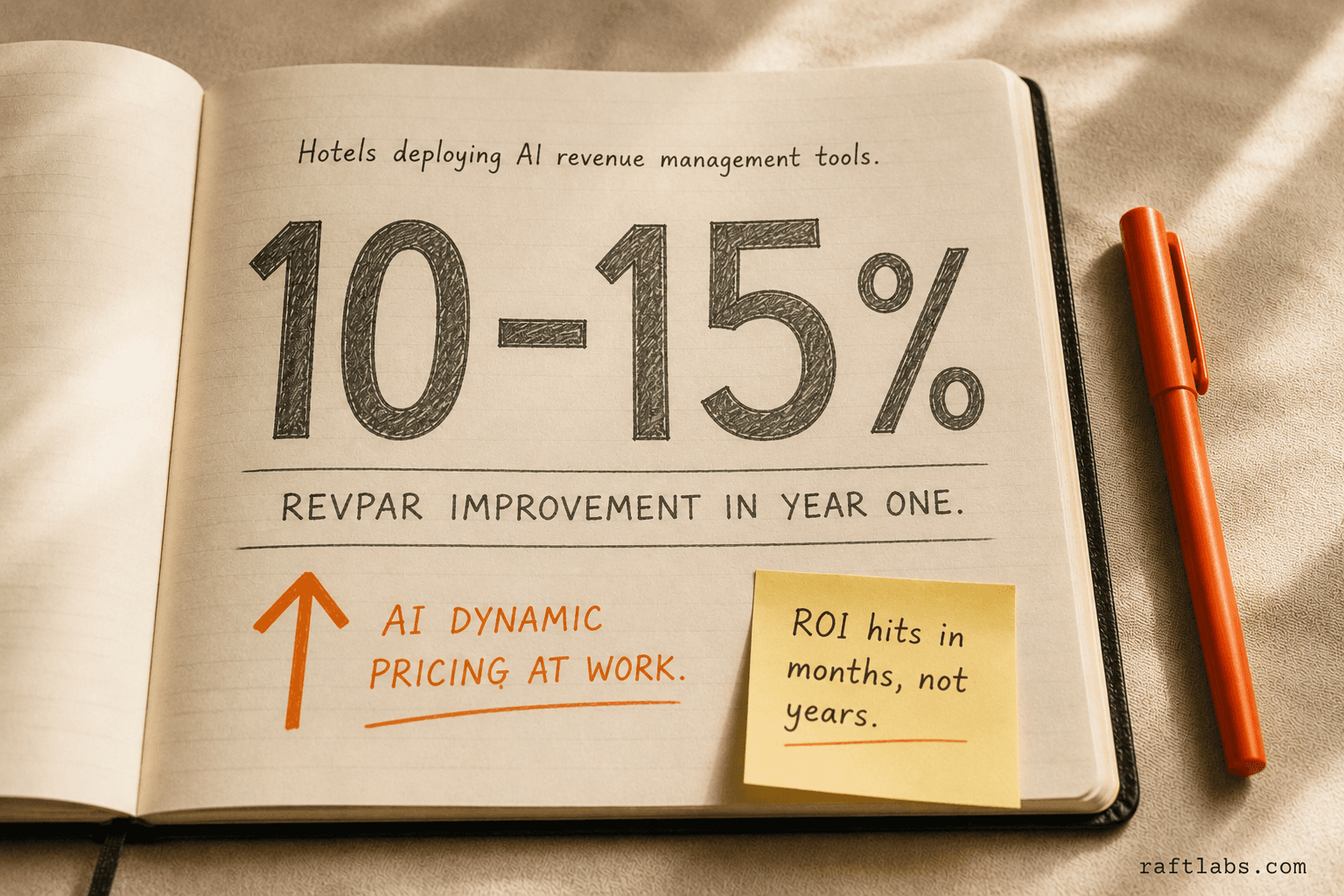
Investing in hospitality tech brings real, visible results. Hotels that use AI-powered revenue tools often see RevPAR climb by 10 to 15 percent. Cloud-based property systems can bring down admin and support costs by close to 30 percent. Your team spends less time sorting backend issues and more time creating better guest experiences.
Smaller and mid-sized hotels that bring in tech for upsells or direct booking tend to see $15-$20 more revenue per night per guest. With digital check-in and billing, the front desk runs leaner, fewer mix-ups happen, and guests move through the experience with ease.
Enterprise PMS platforms are often overbuilt for independent hotels and boutique properties. Building a small hotel management software aligned to your specific operation - room count, booking channels, and reporting needs - typically costs less to run and less to train staff on than adapting a platform designed for chains.
Take Marriott International. They applied AI to personalize offers and run predictive analytics on their loyalty programs and revenue systems. By understanding guest habits, they boosted repeat stays and satisfaction. Combining more revenue, efficient operations, and loyal guests, they achieved roughly ten times the return in three years. Every dollar spent on technology brought nearly ten back in value.
Industry data also shows that hotels using AI for loyalty personalization have seen loyalty revenue rise by up to 35 percent. When your tech works with how the property runs, helps your team do their work, and makes things easy for guests, you see it in smoother service and business growth.
Hotel loyalty programs that run on generic point platforms tend to produce generic engagement. The properties seeing the strongest retention outcomes are building loyalty mechanics into the guest app itself - points tied to in-stay behavior, tier recognition at check-in, and personalized offers based on stay history. The hotel loyalty program approach covers how those systems are built and what drives genuine repeat bookings.
The next five years in hospitality technology
Over the next five years, hospitality technology will increasingly determine which businesses thrive and which lag behind.
1. Startups and boutique properties
Smaller operators can take advantage of cloud-based hotel management systems, AI in hospitality, and mobile-first platforms to compete with bigger brands. Early adoption helps deliver personalized guest services, faster operations, and stronger loyalty. Startups that invest in digital tools strategically often see improvements in booking conversions and repeat stays within the first year.
2. Entrepreneurs and new market entrants
New players in hospitality get a meaningful head start with flexible technology. Systems for bookings, mobile check-ins, and live analytics let them test ideas quickly and adjust as they go. Pricing, inventory, and guest services become easier to manage with real data guiding every decision.
3. Large hotel chains and enterprise operators
For established chains, technology acts as a force multiplier. Hotel PMS integration solutions, hotel CRM integration, and IoT let chains get real-time insights, run predictive revenue management, and deliver consistent, personalized experiences. Automating routine tasks frees staff for guest-facing work, while smart room controls improve the in-room experience. Sustainability tools strengthen positioning with eco-conscious travelers and corporate clients.
4. Impact of media, social platforms, and travel culture
TikTok, Instagram, and YouTube are shaping travel choices. Travelers look for experiences that are immersive and shareable. Properties that use AI suggestions, contactless systems, and smart guest tools to create those moments - and connect all of it cleanly - run better, please guests, and get more visibility online.
5. Global perspective
Properties embracing hospitality technology gain efficiency, higher direct bookings, and happier guests. Emerging markets can adopt the latest tools without legacy constraints, while mature markets need continuous innovation to meet rising expectations. Early adopters consistently outperform peers in operations and revenue growth over a 2-5 year horizon.
The properties that adopt the right mix of AI, cloud, and smart room technology in the next 2-5 years will outperform on revenue, efficiency, and guest loyalty. That gap between early adopters and the rest is already visible in occupancy rates and direct booking conversion.
Hospitality businesses are entering a new phase. Technology now drives results instead of just supporting them. AI, IoT, cloud software, and contactless experiences are key for operators willing to act.
If you're a founder, product leader, or hotel operator, the opportunity is clear. Adopt the right mix of smart technology, integrate your systems, and use data to design experiences your guests will remember.
Start small. Automate one process, connect one platform, or launch one pilot project. Every step builds momentum toward a smarter, more scalable hospitality brand.
At RaftLabs, we help hospitality businesses design and develop modern digital solutions - from mobile apps and management platforms to full system integrations.
Talk to our team and see how technology can make your hospitality business more connected, efficient, and guest-focused.
Ask an AI
Get an instant summary of this post from your preferred AI assistant.
Frequently asked questions
- Costs depend on property size, tech stack, and integration needs. For most mid-sized hospitality businesses such as hotels, resorts, or rental operators, mobile check-in and keyless entry using contactless technology typically range from $10,000 to $35,000. Choosing systems that connect cleanly with your hotel PMS or CRM helps reduce setup time and ongoing costs.
- Yes. AI-powered booking systems and predictive analytics for hotels can analyze guest preferences, optimize pricing, and personalize offers. Many hotels using AI in the hospitality industry report 10-20% growth in direct bookings because guests receive more relevant deals and smoother online journeys.
- Property management system integration is the foundation everything else depends on. A modern, well-integrated PMS that connects cleanly to the booking engine, guest app, CRM, and payment system is what makes every other technology work. Hotels that skip PMS modernisation and bolt new tools on top of a legacy system consistently underperform on both operational efficiency and guest experience. Mobile guest apps and contactless check-in follow closely in terms of immediate guest impact.
- A hotel guest app with mobile check-in, digital key, in-stay service requests, and checkout typically costs $15,000 to $40,000 depending on scope, integrations required, and whether it's built for iOS and Android or web-first. PMS integration is the main cost variable - a well-documented API like Mews or Opera Cloud adds $3,000 to $8,000 in integration work; a legacy system with limited API access can add significantly more. RaftLabs has built guest apps for boutique hotels and serviced apartment brands. See hotel guest app development for scope and timeline details.
- A PMS (Property Management System) is the operational core of a hotel - it manages reservations, room assignments, check-in and checkout, housekeeping status, billing, and reporting. Every other guest-facing technology, from the booking engine to the guest app to the loyalty program, depends on clean data from the PMS. Hotels running on outdated PMS platforms consistently struggle to implement newer technologies because the integration layer doesn't exist or is unreliable. Cloud-based PMS platforms like Mews, Cloudbeds, and Oracle OPERA Cloud have replaced on-premise systems as the standard for properties of all sizes.